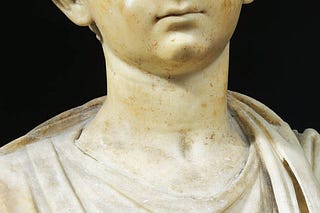
Was Nero Mad?
Was Nero actually as mad as we are led to believe, or is it the result of propaganda?
May 14, 2025·3 min read
The question has occupied scholars for generations, and the answer — insofar as one exists — is rather more complicated than either the ancient sources or modern popular historians would have us believe. To understand the problem properly, we must first strip away two millennia of accumulated mythology and look at what the primary sources actually say, as opposed to what later commentators chose to read into them.
Roman political culture was built on precedent, on the careful accumulation of tradition that the Romans called the mos maiorum — the customs of the ancestors. To deviate from this tradition was not merely politically dangerous; it was a kind of sacrilege, an assault on the fabric of Roman identity itself. This is why even the most ambitious reformers of the late Republic took such pains to dress their innovations in the language of restoration. They were not, they insisted, doing anything new. They were merely returning Rome to its pristine, uncorrupted past.
The evidence from the archaeological record complicates this picture considerably. Excavations carried out in the latter half of the twentieth century have revealed a degree of continuity that the literary sources — themselves products of a particular class with particular interests — consistently underplayed. The Romans were not passive recipients of Greek culture; they were active and often critical consumers, taking what served their purposes and discarding or transforming what did not.
Enjoying this article?
Subscribe to get every new article, translation, and book — delivered to your inbox.
What makes this period so fascinating, and so difficult to assess, is precisely this ambiguity. We are dealing not with a simple story of virtue corrupted or tradition betrayed, but with something altogether messier and more human: a society trying to adapt ancient institutions to circumstances those institutions were never designed to handle, under the pressure of constant military threat, economic instability, and the relentless demands of an empire that stretched from the Scottish borderlands to the Euphrates valley.
The ancient sources are unanimous on at least one point: that the events of these years marked a turning point from which there was no going back. Whether they regarded this as tragedy or as necessary evolution depended almost entirely on when they were writing and whom they were writing for. The historian who composed under a strong emperor had every reason to celebrate the stability that centralised power had brought. The historian writing in the shadow of a tyrant had equally good reason to mourn what had been lost.
Modern scholars have tended to be more cautious, and rightly so. The temptation to impose a teleological narrative — to see Roman history as inevitably moving from republic to empire, from simplicity to decadence, from strength to weakness — is one that has distorted the field for much of its existence. The reality is that Rome's trajectory was neither inevitable nor uniform, and that the men and women who lived through these changes were no more certain of where they were headed than we are about our own future.
It would be a mistake, however, to conclude from this uncertainty that nothing of substance can be said. The sources, for all their biases and limitations, preserve genuine information. The archaeology, for all its fragmentary nature, tells us things the literary record never could. And the comparative evidence from other pre-modern societies allows us to place Roman experience in a broader context that the Romans themselves — understandably — could not have imagined.
You might also enjoy these articles
No Country for Young Men
Augustus was consul at 19. The minimum age was 43. Here's how the age rules worked.
May 7, 2025
Were the Vestal Virgins the First Nuns?
They both have distinctive headwear, are both sworn to chastity, and spend their lives doing religious things.
May 5, 2025
A Banquet of Gaudy Excess
The latest dispatch from the streets, kitchens, and bathhouses of the ancient world.
Apr 30, 2025